You've probably seen the headlines about Tampa Bay being a soft market. Prices are down, inventory is elevated, sellers are making concessions. That's true, broadly speaking.
But inside that broad story is a much sharper one that almost nobody is framing correctly: some Pinellas County coastal zip codes have seen average sale prices fall 30% year-over-year, while Hillsborough County is essentially flat. Those two things happening at the same time, in the same metro, are not the same story.
One is a market cooling. The other is a market repricing. And knowing which one you're in changes every decision you make.
Why Hillsborough and Pinellas are no longer the same conversation
The metro-level number hides the split. Hillsborough County home prices in mid-2025 are essentially flat year-over-year - the same as they were twelve months ago. That's not exciting, but it's stable. Sales volume is holding. Inventory is moderate. The market is digesting higher rates without breaking.
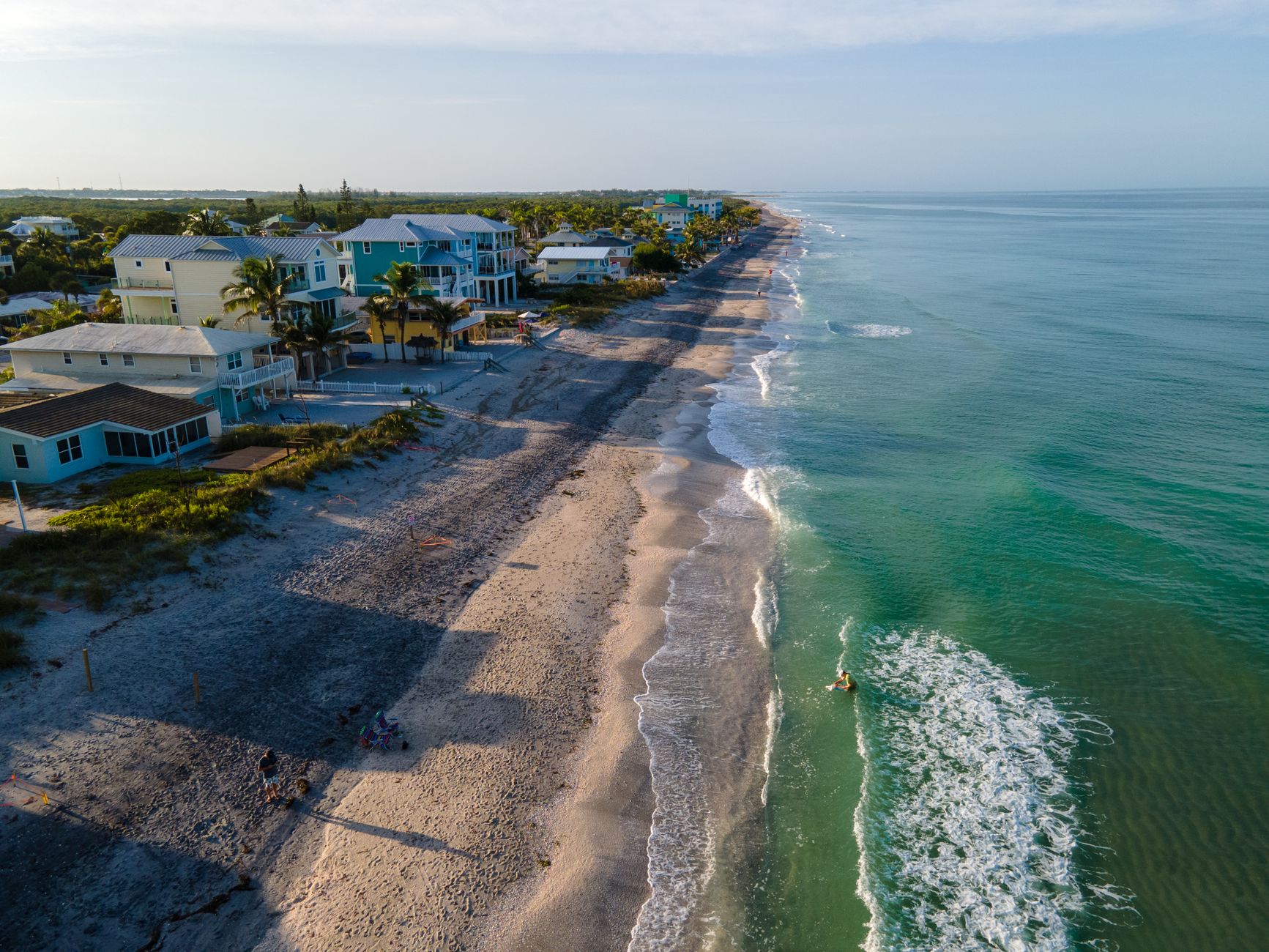
Pinellas tells a completely different story. The county-wide average sale price is down nearly 5.5% year-over-year - and that number is being carried upward by inland Pinellas communities that are performing reasonably well. Strip those out, and focus on the hard-hit coastal zones - St. Pete Beach, Treasure Island, and Northeast St. Petersburg - and average sale prices in those specific areas dropped 30% compared to the prior year.
That number deserves to sit for a second. Thirty percent. That is not a soft market. That is a reclassification.
Estate Vida Tip
If you're comparing a Pinellas beach home to a South Tampa or Westchase home on price per square foot alone, you're making an apples-to-flood-zone comparison. Demand the actual insurance quote, the FEMA flood zone designation, and the Risk Rating 2.0 annual premium before you run any numbers. Those three data points will tell you more than the list price.
What's actually driving it - and why "hurricane recovery" undersells the problem
The easy explanation is Hurricanes Helene and Milton. They hit in late September and early October 2024. The damage was severe and concentrated along the Pinellas coast. That explanation is partially correct.
But it's incomplete in a way that matters enormously to anyone making a buying or selling decision right now.
The hurricane exposed something that was already building underneath these markets: the cost of owning a coastal Pinellas home had become structurally disconnected from what most buyers could actually afford to carry. Insurance premiums, flood coverage, and the psychological weight of annual hurricane season were already eroding demand before the storms hit. The storms accelerated a correction that was already in motion.
Visible evidence of this is all around the coastline. Properties that flooded sit with delayed repairs, overgrown lots, and closed neighboring businesses - conditions that pull the perception of entire blocks downward. Buyers from out of state are arriving with expectations built on pre-storm marketing materials and finding conditions that don't match. That perception gap has real price consequences.
The hurricane didn't create the affordability problem in coastal Pinellas. It revealed one that was already there.
Estate Vida Tip
Sellers in affected Pinellas coastal areas: the buyers who are shopping right now are informed, patient, and almost certainly asking about insurance and FEMA history before they ask about square footage. Get a wind mitigation report and a current insurance quote in hand before your first showing. Buyers who have to discover those numbers themselves - and don't like what they find - will walk. Buyers who receive them upfront can price them in and move forward.
The insurance layer that changes the recovery math
There's a line of thinking that says: coastal Pinellas is down 30%, therefore it's a buying opportunity. Maybe. But that thinking skips the most important question - can you actually afford to own it at today's carrying costs?
FEMA's Risk Rating 2.0, which replaced the old flood insurance pricing model, calculates premiums based on a property's individual flood risk rather than its flood zone designation. That change hit coastal Pinellas hard. Homes that were grandfathered into artificially low NFIP rates for decades are now seeing those rates climb toward actuarial reality - and there's no ceiling on how high they can go over time.
A 30% price reduction means nothing if the annual insurance stack - homeowners, flood, and wind - adds $18,000 to $24,000 per year to the cost of ownership. At those carrying costs, the break-even math on a discounted purchase gets complicated fast, especially with rates still in the mid-6% range.
The positive signal worth noting: Citizens Property Insurance announced a 5.6% average rate reduction for 2025, and Florida Peninsula Insurance has requested an 8.4% premium decrease. Those are real improvements after years of increases. But they are system-wide averages - not coastal-specific relief. A home with documented flood history in an AE zone is not seeing the same benefit as a home in Carrollwood or Wesley Chapel.
Estate Vida Tip
Before making an offer on any Pinellas coastal property, request the full claims history via a C.L.U.E. report and pull the property's current NFIP policy details directly through FloodSmart.gov. If the seller is carrying a pre-2021 grandfathered NFIP rate, understand that rate does not transfer to you at the same cost - and model what a current actuarial premium would do to your monthly payment.
Where the divergence creates actual opportunity
None of this means coastal Pinellas is uninvestable. It means the opportunity has shifted to a specific type of buyer: one who understands the insurance stack, has priced it correctly, is not relying on short-term appreciation to validate the purchase, and is buying for long-term use or long-term hold.
The buyers who will get hurt are the ones treating a 30% discount as a simple value play without modeling the carrying costs. The buyers who could do well are those who are buying primary residences at compressed prices in communities they genuinely want to be in - accepting that the recovery timeline is longer and less predictable than in a standard market correction.
Inland Pinellas - Dunedin, parts of Clearwater, North St. Pete - is a different conversation entirely. Those areas are not carrying the same flood exposure, didn't absorb the same storm damage, and are not seeing 30% price drops. They're more aligned with the Hillsborough story: softer than 2022, but not broken. The mistake is treating all of Pinellas as one market when it's clearly operating as two.
Manatee County is worth watching in this context as well. With more than 497,000 people having relocated to the broader Tampa Bay region since 2020, and with coastal Pinellas becoming structurally more expensive to own, some of that demand is redirecting inland - toward Bradenton's submarket, where the median home price sits around $347,000 and new master-planned construction like the 4,000-home SeaFlower development in west Bradenton is still actively coming to market.
Estate Vida Tip
If you're a buyer who wanted coastal Pinellas but insurance costs are killing the deal, run a parallel search in Dunedin and North St. Pete. You'll find comparable lifestyle, lower flood exposure, and price points that don't require you to absorb a broken insurance equation. The lifestyle trade-off is smaller than most buyers expect.
My read on this
I've watched Pinellas coastal real estate get described as "on sale" for most of the past twelve months, and I think that framing is doing buyers a disservice. Some of those properties are genuinely mispriced and will recover. But a meaningful portion of that 30% drop isn't a hurricane discount - it's the market finally pricing in the actual cost of owning a home in a high-frequency flood zone with rising insurance, aging infrastructure, and climate exposure that wasn't in the original purchase calculus.
What I'd personally watch: the spread between insured and uninsured carrying costs on anything below the base flood elevation in a Pinellas AE or VE zone. If you can't get that number to pencil at today's rates, the discount isn't big enough yet.
What I'd avoid: buying a storm-damaged coastal Pinellas property as a pure price-recovery play with a 12-to-18 month horizon. The macro headwinds - insurance costs, Risk Rating 2.0 trajectory, buyer sentiment - are not resolving that quickly.
Where I see real value: inland Pinellas, North St. Pete, and Dunedin - neighborhoods that got painted with the "Pinellas is down" brush but don't have the underlying risk profile to justify that discount. Those are the zip codes worth analyzing carefully right now, before the rest of the market figures out the same thing.
Questions I'm hearing
Are Pinellas County home prices recovering after the hurricanes?
County-wide prices are still down roughly 5.5% year-over-year, with the hardest-hit coastal areas like St. Pete Beach and Treasure Island showing average sale price declines near 30%. Inland Pinellas communities are holding closer to flat, which means the recovery is highly location-specific - not a countywide rebound.
Is it a good time to buy a beach house in Tampa Bay?
The price compression is real, but carrying costs - particularly flood insurance under FEMA's Risk Rating 2.0 and wind coverage - have risen substantially and don't move in lockstep with purchase price discounts. Model the full annual ownership cost, not just the mortgage, before treating a discounted coastal listing as straightforward value.
Why is Hillsborough County holding value while Pinellas is falling?
Hillsborough doesn't carry the same coastal flood exposure, wasn't directly impacted by Helene and Milton at the same scale, and has a more diverse housing stock that isn't concentrated in flood-zone properties. It's a structural difference in risk profile, not just a matter of storm timing.
Curious how these dynamics play out in a specific zip code or neighborhood you're watching? I'll pull the actual data and walk through what the insurance picture looks like on a specific property type. No sales pitch - just local analysis you can actually use.